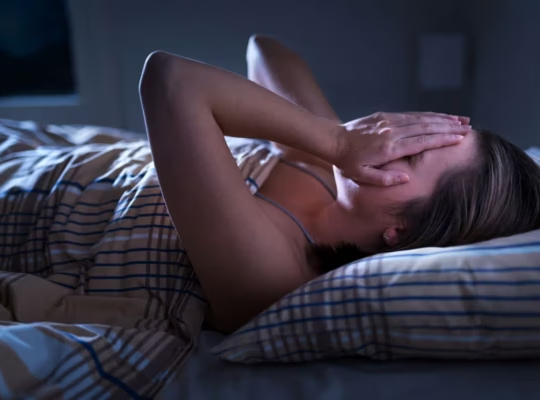
You may notice that your sleepiness arrives at almost the same time each day, even when you slept well the night before. That pattern is not necessarily random. Your chronotype can influence when your body naturally feels more alert and when it begins preparing for sleep.
Chronotype is closely connected with your circadian rhythm, the internal timing system that helps organize sleep and wakefulness. Understanding your natural timing may explain why an early bedtime feels easy for one person but nearly impossible for another.
What your chronotype says about your sleep timing
Your chronotype describes your natural tendency toward earlier or later sleep and wake times. It is not simply a matter of being disciplined or having poor sleep habits.
1. Your body clock helps shape alertness
Your circadian system coordinates daily changes in sleepiness, alertness, body temperature, hormones, and other functions. The National Institute of General Medical Sciences explains that these rhythms follow roughly 24-hour cycles and are strongly influenced by environmental cues such as light.
That means sleepiness does not depend only on how long you have been awake. Your internal clock also helps determine when your brain is naturally more prepared for wakefulness or sleep.
2. Morning and evening types can have different patterns
Some people naturally become sleepy earlier and wake earlier. Others tend to feel more alert later in the evening and prefer a later sleep schedule.
These patterns are often described as morning or evening chronotypes. They exist along a spectrum, so you do not have to fit neatly into either category.
Age can also influence this timing. Sleep researchers have found that circadian preferences tend to change across the lifespan, with later timing becoming more common during adolescence and earlier timing often returning with age.
3. Your schedule can conflict with your biology
The interesting part is what happens when your natural timing does not match your daily obligations.
Someone with a later chronotype may naturally become sleepy later at night but still need to wake early for work. On weekends, that person may sleep later to recover. The difference between preferred timing and required timing can create what researchers call social jet lag.
Over time, that mismatch may leave you feeling less alert at certain parts of the day even when your total sleep time looks reasonable.
What can make your natural sleepiness easier to understand
Knowing your chronotype does not mean you need to completely rearrange your life. It can simply help you recognize patterns that are otherwise easy to mistake for a lack of energy or motivation.
1. Notice when your alertness changes
For a week or two, pay attention to when you naturally feel most awake, when sleepiness begins, and when you feel ready for bed.
Look at the pattern rather than a single day. If your energy and sleepiness repeatedly change at similar times, your internal timing may be part of the explanation.
2. Keep your sleep timing reasonably consistent
Your chronotype is only one part of the picture. Your daily schedule also provides signals that help keep your circadian rhythm organized.
Research on sleep regularity has found associations between more consistent sleep timing and better health outcomes. This does not prove that irregular sleep directly causes health problems, but it supports the idea that consistency matters alongside getting enough sleep.
If your schedule changes dramatically between weekdays and weekends, your body may have more difficulty maintaining a predictable rhythm. A more consistent wake time can provide a steadier signal for your body clock.
3. Use light to reinforce your daytime rhythm
Light is one of the strongest environmental signals for the circadian system. Getting daylight earlier in the day can help reinforce the distinction between daytime and nighttime.
This does not mean morning light will suddenly change your chronotype. Instead, it can provide a useful timing cue for the body clock. Your existing sleep schedule, evening light exposure, and daily routine all work together.
If your sleep timing feels consistently out of sync, understanding your broader sleep schedule can be more useful than simply trying to force yourself to feel sleepy at a particular hour.
4. Pay attention when sleepiness becomes excessive
A predictable period of sleepiness is not automatically a sleep disorder. But severe daytime sleepiness, falling asleep unintentionally, difficulty staying awake while driving, or persistent fatigue deserves more attention.
The National Heart, Lung, and Blood Institute notes that insufficient or poor-quality sleep can affect daytime alertness and functioning. If you regularly feel overwhelmingly sleepy despite allowing enough time for sleep, talk with a healthcare professional rather than assuming your chronotype explains everything.
FAQs about chronotype and sleepiness
What is a chronotype?
A chronotype is your natural tendency toward earlier or later sleep and wake timing. It reflects differences in circadian timing and can be influenced by age, genetics, light exposure, and daily routines.
Can your chronotype change?
Yes. Chronotype is not completely fixed. Circadian preferences can change across life, particularly during adolescence and later adulthood.
Does being an evening type mean you have poor sleep?
No. An evening chronotype does not automatically mean poor sleep. Problems can arise when your preferred timing repeatedly conflicts with work, school, or other obligations.
Conclusion
Your chronotype can influence when you naturally feel alert and when sleepiness begins. That may help explain why certain periods of the day consistently feel easier or harder, even when your sleep duration is adequate.
The goal is not to label yourself as a morning or evening person and stop there. Look at your overall pattern, keep sleep timing reasonably consistent, use daytime light as a natural timing cue, and pay attention if excessive sleepiness continues despite adequate sleep.
References
National Institute of General Medical Sciences. https://www.nigms.nih.gov/
National Heart, Lung, and Blood Institute. https://www.nhlbi.nih.gov/
National Institutes of Health, PubMed. https://pubmed.ncbi.nlm.nih.gov/
Centers for Disease Control and Prevention. https://www.cdc.gov/
Yu Sleep
If you are looking for additional support for better sleep, Yu Sleep offers a natural wellness approach designed to support relaxation and healthier sleep habits.
Learn More About Yu SleepGet Simple Health Tips
Join our newsletter for practical tips, prevention strategies, and healthy lifestyle advice.
Medical Disclaimer
This content is for informational purposes only and should not be considered medical advice. Always consult a qualified healthcare professional. Read our Disclaimer.